
Table of Contents
- What a Minimalist Capsule Wardrobe Actually Means
- How to Start a Capsule Wardrobe: The 3-3-3 Framework
- The 10 Essential Items for a Minimalist Capsule Wardrobe
- Building a Capsule Wardrobe Color Palette That Works Year-Round
- Your Capsule Wardrobe Checklist: From Closet Audit to Final Purchase
- Budget-Friendly vs. Investment Pieces: A Cost-Per-Wear Breakdown
- Sustainable Fabric Care and Clothing Longevity
- Capsule Wardrobes for Different Body Types and Settings
- Frequently Asked Questions
Last Updated: September 23, 2026
What a Minimalist Capsule Wardrobe Actually Means
A minimalist capsule wardrobe is a small, curated collection where every piece works with the others. Most capsules land between 20 and 40 items, not counting underwear, sleepwear, or workout gear. This guide from Velour and Vine breaks down the 10 essential items that form its backbone.
How to Start a Capsule Wardrobe: The 3-3-3 Framework
The simplest way to start a capsule wardrobe is the 3-3-3 framework: pick three tops, three bottoms, and three layers you already love, a low-pressure starting point that stops you from overthinking.
- Choose 3 tops you reach for without thinking
- Choose 3 bottoms that fit well and feel comfortable
- Choose 3 layers you can add or remove as the day changes
- Wear only those nine pieces for one week
- Note what's missing and what you never touched
The Wardrobe Edit: What to Keep and What to Let Go
The wardrobe edit is where most capsules succeed or fail. A common mistake is keeping clothes for a version of yourself you're not dressing anymore, the aspirational dress, the too-small jeans, the "someday" blazer. Those items add weight, not value.
Use this filter for each piece:
- Does it fit right now?
- Did you wear it in the last 12 months?
- Does it mix with at least three other items?
- Does it still feel like you?
The 10 Essential Items for a Minimalist Capsule Wardrobe
The 10 essential items for a minimalist capsule wardrobe cover four categories: tops, bottoms, outerwear, and footwear. Get these right and you can dress for almost any situation.
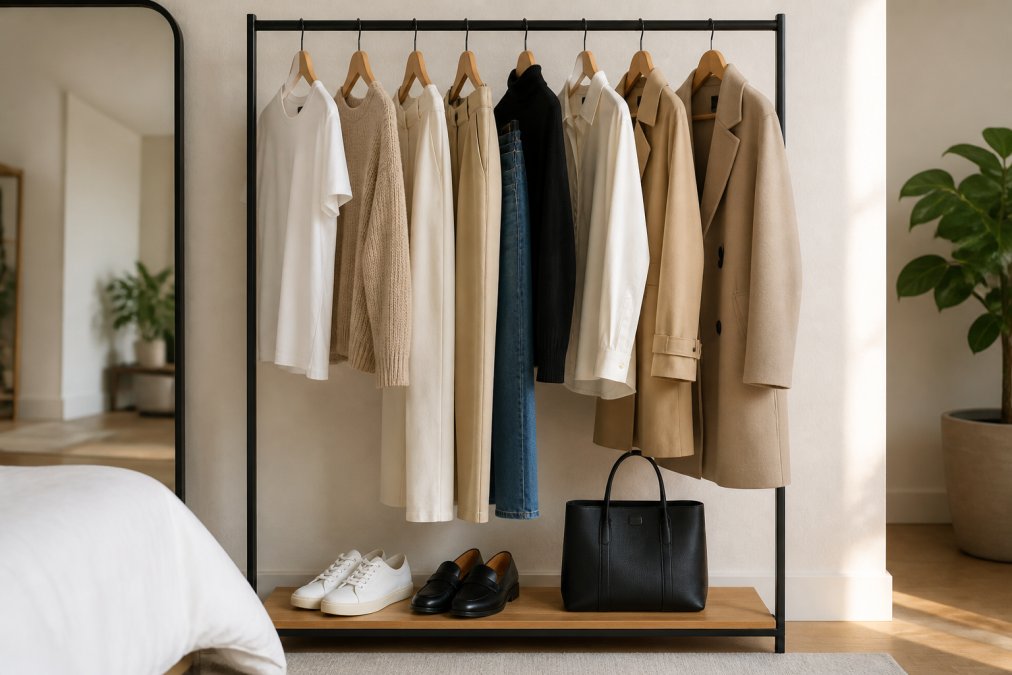
Tops and Layers: Tees, Tanks, Blouses, and Knitwear
Tops and layers sit closest to your body, so comfort and fit matter most.
Bottoms and Outerwear: Straight-Leg Trousers, Skirts, and a Structured Coat
Bottoms and outerwear set the tone; neutral colors keep everything interchangeable.
Footwear and Accessories That Finish the Look
Footwear and accessories stop a capsule feeling plain. Two good pairs of shoes and a few accessories cover most days.
Building a Capsule Wardrobe Color Palette That Works Year-Round
A capsule wardrobe color palette is the set of two to three base colors plus one or two accents that every piece shares. A tight palette makes a small wardrobe feel large.
A simple palette structure:
| Layer | Color Choice | Example |
|---|---|---|
| Base neutrals | 2-3 colors | Black, cream, camel |
| Accent | 1 color | Olive green |
| Metals | 1 tone | Gold or silver |
Your Capsule Wardrobe Checklist: From Closet Audit to Final Purchase
A capsule wardrobe checklist keeps the process on track. Work through it in order and you won't buy things you regret.
- Pull everything out of your closet
- Sort into keep, store, and let go
- Note the gaps in your 10 essentials
- Choose your 2-3 base colors
- Pick one accent color
- List the pieces you still need
- Buy only what's on the list
- Try 3 outfits from the new mix before buying more
Budget-Friendly vs. Investment Pieces: A Cost-Per-Wear Breakdown
Cost-per-wear is the real price of a piece: cost divided by number of wears. A cheap item worn twice costs more per wear than a pricier item worn 100 times. But you also need to know which of the 10 essentials are worth spending on.
The Save vs. Splurge Matrix for the 10 Essentials
Not all essentials are equal. Some are worn daily and need to hold up; others are worn occasionally and can be more budget-friendly. Use this matrix to prioritize spending.
| Essential Item | Recommendation | Why |
|---|---|---|
| 1. Plain white tee | Save | Tees are worn close to the body and need frequent washing. They wear out faster than other pieces. A mid-range tee with a good fit is fine; replace as needed. |
| 2. Neutral tank or camisole | Save | Similar to tees, tanks are layering pieces that get washed often. Focus on fit and fabric feel, not brand. |
| 3. Well-cut blouse | Splurge | A blouse is a step-up piece that reads polished. A well-made blouse with quality fabric and a clean cut will last longer and look better. |
| 4. Fine-knit sweater | Splurge | Knitwear is prone to pilling and stretching. A higher-quality knit (merino wool, cashmere blend) holds its shape and looks better over time. |
| 5. Straight-leg trousers | Splurge | Trousers are worn frequently and need to hold their shape. A well-tailored pair in a durable fabric (wool blend, cotton twill) is worth the investment. |
| 6. Dark-wash jeans | Splurge | Denim is a casual anchor. A good pair of jeans with a bit of stretch and a dark wash will last years. Cheap jeans lose shape and fade quickly. |
| 7. Midi skirt | Save | Skirts are often worn less frequently than trousers or jeans. A mid-range skirt in a solid color works well. |
| 8. Structured coat | Splurge | This is your investment piece. A structured coat is worn over everything and should last for years. Look for quality wool or a wool blend. |
| 9. Leather sneakers or loafers | Splurge | Footwear takes a beating. Cheap shoes wear out fast and can be uncomfortable. A well-made pair of leather sneakers or loafers can be resoled and worn for years. |
| 10. Ankle boots or low heel | Splurge | Like sneakers, boots and heels are worn often and need to be comfortable and durable. A quality pair will outlast several cheap pairs. |
How to Calculate Your True Cost-Per-Wear
Estimate cost-per-wear before you buy:
Cost-per-wear = Purchase price ÷ Estimated number of wears
For example:
- A $30 tee worn 30 times = $1 per wear
- A $100 blouse worn 100 times = $1 per wear
- A $300 coat worn 300 times = $1 per wear
The goal is the lowest cost-per-wear while maintaining quality and fit. A pricier item worn often beats a cheap item you rarely wear.
Where to Save and Where to Spend: A Practical Approach
If you are building your capsule on a budget, you do not have to buy everything at once. Here is a phased approach:
Phase 1: Foundation (months 1-3)
- Invest in daily pieces: straight-leg trousers, dark-wash jeans, and one pair of shoes.
- Save on tees, tanks, and the midi skirt, buy mid-range versions that fit well.
Phase 2: Layering (months 4-6)
- Add the fine-knit sweater and well-cut blouse, spending a bit more if you can.
- If you need a coat, invest now. A structured coat is a long-term purchase.
Phase 3: Finishing touches (months 7-12)
- Add the second pair of shoes (ankle boots or low heel).
- Replace any tees or tanks that have worn out.
The Role of Quality in Cost-Per-Wear
Quality is about materials, construction, and how well a piece holds up. When evaluating a purchase, look for:
- Fabric content: Natural fibers like cotton, wool, and silk breathe better and last longer than synthetic blends. A small percentage of elastane (2-4%) adds stretch and recovery.
- Stitching and seams: Look for clean, reinforced seams. French or bound seams signal quality.
- Hardware: Buttons, zippers, and snaps should feel solid; cheap hardware breaks or tarnishes quickly.
- Lining: For coats and trousers, a quality lining (like viscose or cupro) adds comfort and structure.
Sustainable Fabric Care and Clothing Longevity
How you care for clothes decides how long they last. Most capsules fall apart not from overuse but from poor washing and storage.
Simple habits that extend clothing life:
- Wash less often, and air items between wears
- Use cold water and a gentle cycle
- Turn knits inside out and lay them flat to dry
- Store folded knits, not hung, to keep their shape
- Repair small issues early, before they spread
Capsule Wardrobes for Different Body Types and Settings
A capsule wardrobe should fit your body and your life, not a template. The 10 essentials stay the same in name, but cut, rise, and fabric change with your proportions and where you spend your days. Here's how to adapt them for different body types and the two most common settings: professional and casual.
Adapting the 10 Essentials for Your Body Type
Most capsule guides call straight-leg trousers and a plain white tee universal, but that only works if the fit is right. Here's how to adjust the core pieces for three common body types.
For petite frames (generally under 5'4"):
- Straight-leg trousers: Choose a high-rise cut with a cropped or ankle length. A rise at or above the natural waist elongates the leg line. Avoid fabric pooling at the ankle.
- White tee: Look for a slightly fitted or semi-fitted silhouette. An oversized tee can overwhelm a petite frame. Tuck it in to define the waist.
- Structured coat: Opt for a coat that ends at the hip or mid-thigh. Longline coats can swallow your frame. A single-breasted style with a defined waist works well.
- Midi skirt: Choose a midi that hits at the narrowest part of your calf, not the widest. A slit can add movement without adding bulk.
For tall frames (generally over 5'9"):
-
Straight-leg trousers: Look for a full-length inseam that grazes the top of your shoe. A mid-rise or high-rise works, but ensure the hem is long enough. Many brands offer tall sizes; use them.
-
White tee: A longer hem and slightly relaxed fit balance your proportions. Avoid cropped tees unless you want to emphasize your waist.
-
Structured coat: A longline or knee-length coat suits tall frames. Double-breasted styles add visual weight that balances height.
-
Midi skirt: A true midi (hitting mid-calf) works well. Maxi lengths also work if you want a dramatic line.
-
Straight-leg trousers: Look for a cut that skims your hips and thighs without clinging. A mid-rise or high-rise with a contoured waistband prevents gapping at the back. Fabrics with a bit of stretch (2-4% elastane) help hold shape.
-
White tee: A V-neck or scoop neck draws the eye vertically. A slightly fitted tee that follows your curves without pulling works best. Avoid boxy cuts that hide your shape.
-
Structured coat: Choose a coat with a defined waist or a belt. A wrap coat or a single-breasted style with princess seams flatters curves. Avoid double-breasted styles that add bulk.
-
Midi skirt: A-line or bias-cut skirts skim over hips and thighs. A wrap skirt also works well. Avoid stiff, pencil skirts unless they have a back slit for movement.
Professional vs. Casual: Building Outfits for Both Settings
Most capsule guides assume a casual lifestyle, but many people need a wardrobe that transitions from a home office to a client meeting. The 10 essentials can cover both if you know how to style them.
For professional settings (office, meetings, presentations):
- Tops: Lead with the well-cut blouse and fine-knit sweater. A blouse tucked into straight-leg trousers with a structured coat reads polished. A fine-knit sweater over a collared shirt adds warmth without bulk.
- Bottoms: Straight-leg trousers in a dark neutral are your workhorse. Dark-wash jeans can work in business-casual offices if paired with a blazer or structured coat.
- Outerwear: The structured coat is non-negotiable. It instantly elevates even a simple tee-and-trousers combination.
- Footwear: Loafers or a low heel are appropriate for most offices. Clean leather sneakers can work in creative fields.
- Accessories: A structured bag and simple jewelry complete the look.
For casual settings (remote work, weekends, errands):
- Tops: The plain white tee and neutral tank are your base. Layer with the fine-knit sweater or wear alone.
- Bottoms: Dark-wash jeans and the midi skirt are your casual anchors. Straight-leg trousers can also be dressed down with sneakers and a tee.
- Outerwear: The structured coat works, but you can also add a lighter layer like a denim jacket or utility jacket if your capsule allows for seasonal extras.
- Footwear: Leather sneakers are the casual default. Ankle boots work for cooler weather.
- Accessories: Keep it minimal. A crossbody bag and a simple belt.
The work-from-home-to-office transition:
- A fine-knit sweater can be worn with sweatpants at home and with tailored trousers in the office.
- Dark-wash jeans can be paired with a tee and sneakers for home, then with a blouse and loafers for the office.
- A structured coat can be thrown over any outfit to instantly make it office-appropriate.
Frequently Asked Questions
What is the 3-3-3 rule for a minimalist capsule wardrobe?
The 3-3-3 rule is a starting framework: three tops, three bottoms, and three pairs of shoes that all work together. It creates nine outfit combinations from just nine items. The logic is interchangeable dressing: every piece should match every other piece in color and formality. Once you are comfortable with nine items, you can expand to the full 10 essential items for a minimalist capsule wardrobe. The rule works best when you stick to a neutral palette of two or three core colors plus one accent.
How do you choose the 10 essential items for a minimalist wardrobe?
Start with your actual weekly routine. If you work from home, prioritize comfortable tops, relaxed but tailored trousers, and a soft layer for video calls. If you go into an office, add a structured blazer or coat. Choose items that survive at least three outfit combinations each. Aim for two tops, two bottoms, two layers, one outerwear piece, one pair of shoes, and two accessories. Test each piece against your capsule wardrobe color palette before buying.
How do you maintain a minimalist wardrobe with limited space?
Use vertical folding for knits and tees, which cuts drawer space by roughly a third compared to flat stacking. Hang structured pieces like coats and tailored trousers on slim velvet hangers to save rail width. Store off-season items in a single under-bed box, not scattered across closets. Keep a donate bag nearby so anything you have not worn in three months leaves immediately. A capsule wardrobe checklist helps you track what you own so you avoid buying duplicates.
What are the benefits of a 10-item capsule wardrobe?
A 10-item capsule wardrobe cuts decision fatigue because every piece works with every other piece. You spend less time choosing outfits and more time on your day. Cost-per-wear drops because you wear each item far more often than a fast-fashion purchase. It also reduces clutter: fewer items means less closet organization work and easier seasonal rotation. For remote workers, a tight capsule keeps video-call outfits consistent without requiring a full closet of options.
Building a capsule wardrobe takes honesty and a little patience. The hardest part isn't picking the 10 items, it's letting go of the ones that don't fit your life anymore. Velour and Vine makes that easier with intentionally designed pieces built around sleek silhouettes and functional comfort, so every item you add earns its place. Start with the essentials, choose your palette, and dress with intention. Shop now →